A Change is Coming.
A Free, Community Owned Alternative to Dexscreener, DexSocials

Who We Are
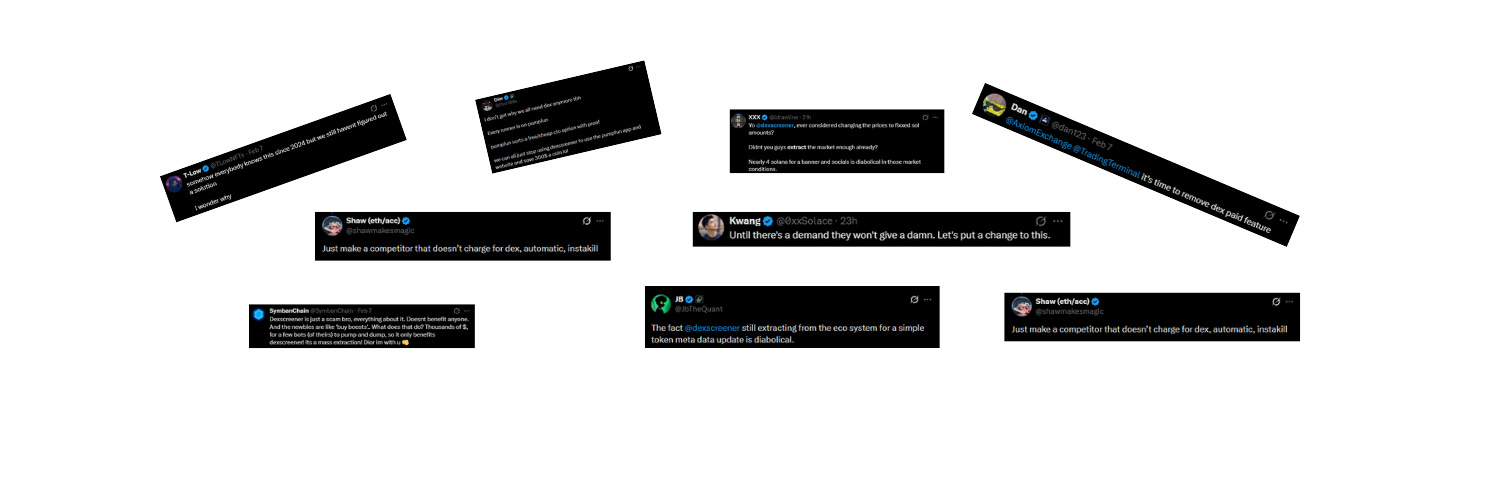
DexSocials is being built by a small group of people who have been around this space long enough to see the same infrastructure problems repeat over and over. We have built projects, launched tokens, operated CTOs, integrated APIs, and dealt firsthand with the consequences of relying on centralized platforms for basic token metadata and identity. The current system works, but it works in a way that is extractive, opaque, and misaligned with the interests of both users and builders.
Rather than waiting for existing platforms to change their incentives, we decided to build an alternative that treats token identity as public infrastructure rather than a monetization surface. DexSocials is not starting out as a perfect, finished product. It is being built in public, iterated on quickly, and shaped based on feedback from people actually operating terminals, bots, dashboards, and CTO communities. Early adopters will have direct influence on how verification, metadata standards, and integration patterns evolve.
We are actively looking for feedback from teams building trading terminals, analytics tools, bots, explorers, and portfolio trackers. If you integrate DexSocials and find limitations in the API, missing fields, edge cases in token identity, or abuse vectors we have not considered, that input directly informs how the system evolves. The goal is to build infrastructure that fits real world usage patterns, not a closed product designed in isolation.
What DexSocials Is Actually Building
DexSocials is being designed as a public utility layer for token identity rather than another trading terminal or charting frontend. While charts and price views are widely available, the underlying identity layer that maps token contracts to official links and metadata remains centralized behind closed platforms that charge recurring fees and provide no meaningful verification. This has created a situation where token identity is effectively pay to update and vulnerable to abuse by bad actors.
Our approach is to separate token identity from proprietary terminals and expose it as an open data layer that any interface can consume. DexSocials provides a free REST API that allows trading terminals, bots, dashboards, explorers, and analytics tools to fetch canonical token metadata directly by contract address. This includes name, ticker, description, icon, banner, website, X account, Telegram link, and CTO status. The API is designed to be simple to integrate into existing systems and mirror the same data terminals already rely on today, without paywalls or vendor lock in.
What This Enables
By standardizing token identity into a public API layer, DexSocials enables:
Trading terminals to display token links and metadata without relying on a single proprietary provider
CTOs to coordinate around a shared source of truth for official project identity
Bots and dashboards to resolve token metadata programmatically by contract address
Users to see whether token links are community approved rather than simply whoever paid most recently
This allows token discovery and identity to become neutral infrastructure instead of a monetized choke point.
Free Token Metadata as Base Infrastructure
Linking metadata to a token should be treated as base layer infrastructure for the ecosystem rather than a premium feature. Token identity is a core primitive that users rely on to avoid scams, verify legitimacy, and find official project resources. DexSocials is being built with the explicit intention that linking and updating token metadata remains free to use long term, including official websites, X accounts, Telegram links, banners, icons, and descriptive information associated with a token address.
By removing paywalls around basic metadata updates, the incentive structure shifts away from monetizing legitimacy and toward maintaining accurate, verifiable information. This reduces the ability for malicious actors to buy visibility while lowering friction for legitimate projects and CTOs who need to correct or update information quickly.
CTO Verification and Link Approval
A major failure mode of existing platforms is that malicious actors can pay to update token links to phishing sites and drainers with no meaningful verification. DexSocials is actively playtesting multiple approaches to CTO verification and link approval to address this problem in a way that balances security, usability, and resistance to abuse.
The first method we are testing is a social verification model where CTO claims and metadata updates require approval from multiple independent X users. The initial threshold being tested is five X accounts voting in favor of an update before it is marked as approved. This threshold and mechanism are not final and are expected to evolve as we gather feedback and observe real usage patterns.
We are starting with X based verification rather than wallet based voting because creating multiple X accounts with real activity and reputation is significantly more difficult than creating multiple wallets. Wallet based voting systems are trivial to sybil attack in environments where spinning up new wallets is cheap and automated. Social verification introduces friction for bad actors while still remaining accessible to legitimate community members. Hybrid models and additional verification layers are being explored as part of this experimentation phase.
REST API for Terminals, Bots, and Dashboards
DexSocials exposes token identity through a REST API that resolves metadata by token contract address. This allows terminals and tooling to integrate with minimal changes to their existing architecture. The API is designed to be read optimized, cache friendly, and suitable for high volume usage by price trackers, explorers, bots, and portfolio dashboards.
At the current stage, the API is free to use and does not enforce rate limits. This may evolve over time as usage grows and abuse patterns emerge, but the core principle remains that access to token identity should not be gated behind per update fees or closed partnerships. The API is intended to be a drop in replacement for existing token metadata endpoints used across the ecosystem.
Distribution and Integrations Are the Real Bottleneck
Open infrastructure only matters if it is actually used. The influence of existing platforms comes primarily from distribution and default integrations, not from superior technical design. For DexSocials to reduce extractive behavior in the ecosystem, trading terminals, bots, explorers, and analytics platforms need to integrate open token identity sources instead of relying on closed APIs that monetize basic metadata updates.
This is where community support becomes critical. If you operate a terminal, bot, or analytics tool, consider integrating DexSocials as a token identity source and provide feedback on what would make adoption easier. If you are a CTO or project lead, ask the terminals you use to pull token links from DexSocials instead of proprietary providers. If you are a user, tag terminals on X and ask them to support open token identity infrastructure.
This is not about creating a new monopoly. The goal is to make token identity boring, neutral, and non extractive so no single platform can tax the ecosystem for basic infrastructure again.
where is toly’s restack?